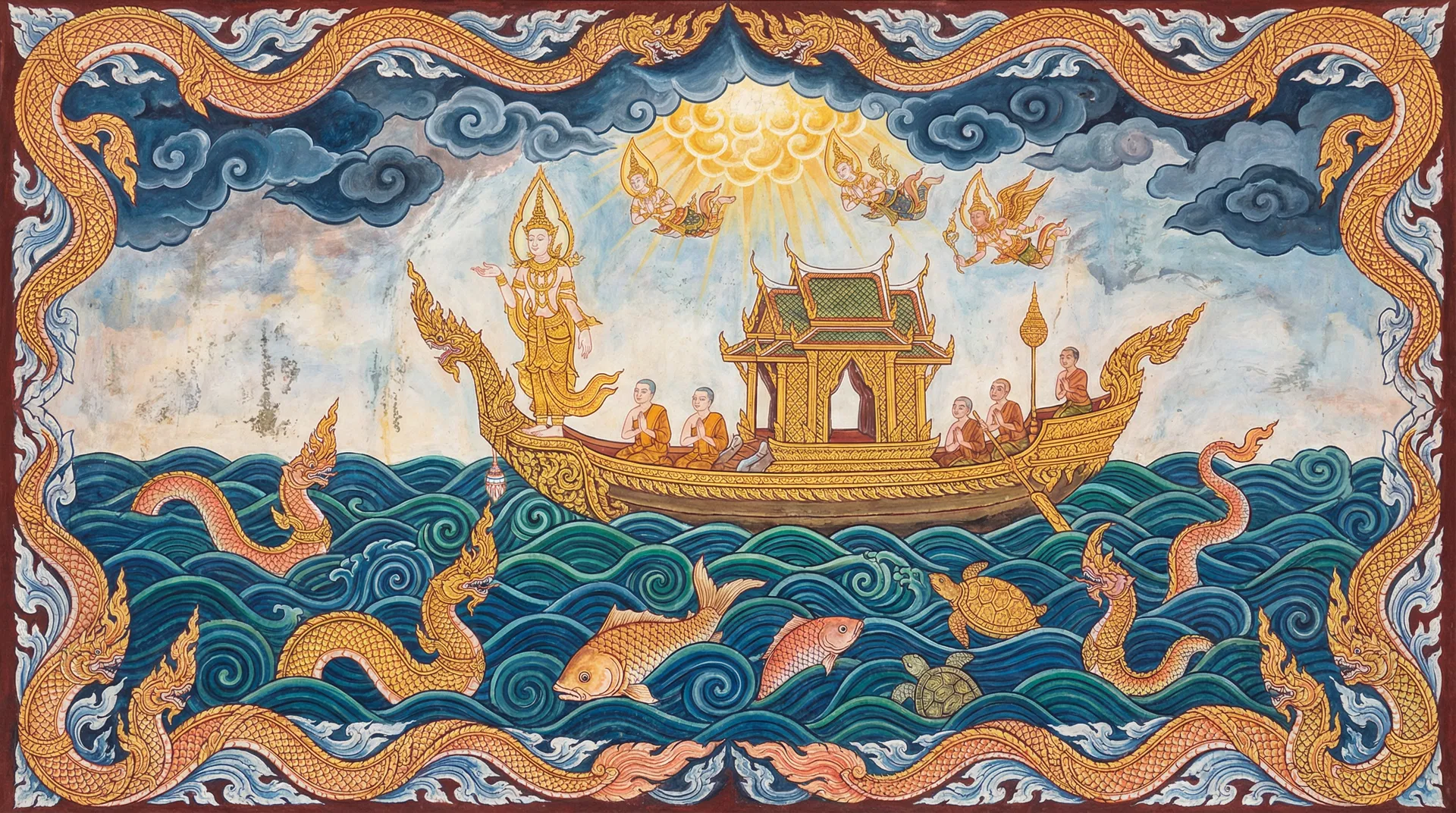
Vessantara Jataka
Vessantara Jataka
In the magnificent kingdom of Siwi, ruled a king named Sañjaya, a monarch of great virtue and boundless compassion. His queen, Phusati, was equally noble, and together they presided over a land of peace and prosperity. Their son, Prince Vessantara, was the embodiment of perfection, a prince whose generosity knew no bounds. From his very birth, it was clear that he was destined for greatness, his heart overflowing with a desire to give, to share, and to alleviate the suffering of all beings.
His most prized possession was a magnificent white elephant, an auspicious creature named Candaka, said to possess the power to bring rain to the land. One fateful day, a delegation of Brahmins from a neighboring, drought-stricken kingdom arrived at King Sañjaya's court. Their land was parched, their crops withered, and their people were starving. They pleaded with King Sañjaya for help, their voices hoarse with desperation.
King Sañjaya, though moved by their plight, could not part with the white elephant, for it was a symbol of his kingdom's prosperity and a promise of rain. However, Prince Vessantara, witnessing the Brahmins' suffering, felt his compassionate heart ache. He could not bear to see them leave empty-handed. In an act of unparalleled generosity, he decided to give them his beloved white elephant, Candaka.
"Take Candaka," Vessantara declared, his voice filled with unwavering resolve. "May this noble creature bring rain and sustenance to your parched land."
The Brahmins rejoiced, and with Candaka leading the way, they departed. However, news of Vessantara's act of extreme generosity quickly reached the ears of King Sañjaya. While proud of his son's compassionate spirit, the King was also concerned about the implications of giving away such a vital symbol of their kingdom's well-being. He summoned Vessantara to his presence.
"My son," King Sañjaya said, his voice gentle but firm, "your compassion is indeed noble, but your gift has caused great concern. The people fear that without Candaka, our land may suffer. You must understand the responsibilities of a prince."
Vessantara, however, remained steadfast in his conviction. "Father," he replied, "true giving is selfless. It seeks no reward, and it recognizes no boundary. If my gift can alleviate suffering, then it is a gift well given."
The people of Siwi, however, were not as understanding. They grumbled and complained, fearing for their own future. Their discontent reached the ears of King Sañjaya, who, despite his own pride in Vessantara's virtue, felt compelled to address the people's concerns. He decided that, to appease his subjects and to uphold the kingdom's stability, Vessantara must leave the kingdom for a time.
"My son," King Sañjaya announced, his heart heavy, "your generosity, while virtuous, has caused unease among the people. For the sake of harmony, you must reside in the forest for a period, until the people's fears subside."
And so, Prince Vessantara, along with his devoted wife Princess Maddi and their two young children, Prince Jali and Princess Kanha, retreated into the dense forests of Dantapura. They lived a simple life, dwelling in a hermitage, their days filled with meditation and service to the ascetics who resided there.
One day, as Vessantara was meditating, an old Brahmin named Jujaka arrived at their hermitage. Jujaka was a man consumed by greed and envy. He had heard tales of Vessantara's legendary generosity and saw an opportunity to enrich himself. He approached Vessantara with a cunning request.
"Noble prince," Jujaka wheezed, his eyes glinting, "I have traveled far. My village is in great need. I beg of you, grant me your two children, Prince Jali and Princess Kanha, to help me with my chores. They are strong and capable, and they will surely bring you good fortune."
Vessantara, though his heart pounded with a father's love and a pang of sorrow, saw this as the ultimate test of his vow of generosity. He knew that the suffering of Jujaka, however self-inflicted, was real to him. With a heavy sigh, and with the understanding that true giving meant relinquishing even that which is most precious, Vessantara agreed.
Princess Maddi, who was gathering fruits in the forest, returned to find her children gone. Distraught and heartbroken, she learned from Vessantara of his gift to Jujaka. She pleaded with him, her tears flowing like a river, but Vessantara remained resolute, explaining the profound spiritual significance of his sacrifice.
Jujaka, meanwhile, took the children and intended to sell them. However, the gods, witnessing Vessantara's ultimate act of sacrifice, intervened. Sakka, the king of the gods, disguised himself as a wealthy Brahmin and intercepted Jujaka. He bought the children from Jujaka, ensuring their safe return to their grandfather, King Sañjaya, and rewarding Jujaka with riches, thus fulfilling Vessantara's intention of alleviating suffering.
King Sañjaya, overjoyed to have his grandchildren back, was also deeply moved by his son's ultimate sacrifice. He realized that Vessantara had indeed achieved the pinnacle of generosity, a perfection beyond human comprehension.
The story of Prince Vessantara became a legend, a testament to the boundless nature of compassion and the ultimate power of selfless giving. It is said that through this act, Bodhisattva perfected his Paramita, reaching the highest aspiration of a Bodhisattva's path, paving the way for his eventual enlightenment.
— In-Article Ad —
💡Moral of the Story
True generosity means sacrificing even the most precious possessions, including one's own children, for the sake of alleviating the suffering of others. This ultimate act of selflessness is the highest form of compassion.
Perfection: Generosity (Dana) to its absolute extreme
— Ad Space (728x90) —
More Jataka Tales You May Enjoy
 86Ekanipāta
The Great Vanga Jataka
Once upon a time, in the glorious city of Savatthi, while the Supreme Buddha resided at Jetavana Mon...
💡 True compassion lies in the willingness to sacrifice one's own well-being for the benefit of others, and such selfless acts can bring about miraculous positive change.
 545Mahānipāta
Sattubhatta Jātaka
The King's Feast and the Virtuous MonkIn the grand kingdom of Kosala, ruled a king named Pasenadi, a...
💡 True contentment and spiritual progress are achieved through simplicity, self-control, and detachment from worldly desires, not through material wealth or indulgence.
148EkanipātaMahasutasoma Jataka
Mahasutasoma JatakaIn the magnificent city of Indapatta, ruled a king named Pothila, whose reign was...
💡 True strength lies not in retaliation or aggression, but in unwavering adherence to non-violence, wisdom, and mercy, which can transform enemies into allies and overcome evil with good.
 179Dukanipāta
Mahāpuṇṇa Jātaka
Mahāpuṇṇa JātakaIn the heart of the kingdom of Kasi, a land blessed with fertile soil and a prospero...
💡 By consciously pausing and reflecting when anger arises, one can gain control over impulsive reactions, leading to wiser decisions, improved relationships, and inner peace. Cultivating patience and understanding is a path to great merit.
159DukanipātaNimi Jataka
Nimi JatakaIn the ancient land of Videha, there ruled a king named Nimi. King Nimi was a paragon of ...
💡 Understanding the law of karma and the consequences of one's actions is essential for cultivating virtue and progressing towards liberation.
8EkanipātaThe Wise King of Birds
The Wise King of BirdsPerched atop the highest peak of the Himalayas, where the air was thin and cry...
💡 True wisdom lies in selfless compassion, and the greatest sacrifices bring about miraculous salvation.
— Multiplex Ad —